 Awareness is the key. But what does the word mean to you? To most people, perhaps, it denotes an acknowledgement of that which is going on around them in a general sort of way. In the context of meditation, however, it means ‘waking up’, becoming acutely sensitive, knowing, feeling, living the moment in its pristine state, sensing colours and contours, sounds, textures, smells, recognising tendencies within oneself yet resisting the pull to be controlled by them — this is meditation, to begin with at least.
Life is a bit of a game really, isn’t it? We look forward to something and when it comes we criticise it, resent it, worry about it, want to change it, want to make it better.
Why do so many beings have to endure hunger and cold, heat, disease, cruelty, physical and mental abuse and deprivation, torture, injustice, and all the rest of it? Some have to go through a living hell, don’t they? And others suffer because there isn’t any cheese in the fridge.
The Buddha expressed what he experienced. ‘We suffer,’ he said, ‘from wanting what we do not already have.’ ‘Yes,’ you may say, ‘and what else?’ Well, nothing else. That seems to be it. The cause of all suffering is yearning, wanting, wishing, desiring. It doesn’t sound much of a reason. What about the husband? . . the wife? . . the job? . . the weather? What about the pain in my arm?
You cannot change the past, arrange the future to suit yourself, or make other people say and do the things you want them to say and do. All of your power is contained within this moment, related to this particular body and mind. And this is a very powerful position to be in.
The Buddha sat alone, accompanied merely by his own deep honesty and awareness until the barriers to truth were shattered. Over the centuries all sorts of elaborate practices have been built onto this simple approach.
The Buddha didn’t really have a method other than awareness, and awareness is no method at all; it is a straightforward ‘opening of the eyes’, a kind of waking up as if from a dream. That is all! But that is everything.
 Anyone who wants to meditate can, but some have psychological needs which are not necessarily met by delving into the labyrinths of the mind unassisted. Do what is right for you.
If we think about what we see, hear, smell, taste and touch, instead of just seeing, hearing, smelling, tasting and touching, we do not get the full flavour of the experience.
Try doing a job, any job, without thinking about the job itself or anything else besides. Simply stay with the body.
Stay with the process, the action in the body. Avoid functioning from inside the head. Allow the action to do itself very naturally in the body. That is experience without thought, beyond thought; it is undistorted and unadulterated experience; nothing has been added to the process, and nothing taken away.
All situations are immediately known for what they are without the aid of thought. In fact, thinking usually only confounds the mind.
 Thinking is, of course, part of life too, and in certain forms it is invaluable. Wisely reflecting, skilfully planning, contemplating — these are creative forms of thought; but this is not the kind of thinking I am talking about, and it is not the sort most of us engage in for most of the time.
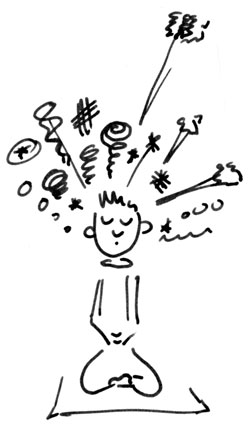
Passing thoughts arise — that is natural, and they can bring us inspiration. But when one indulges in those passing thoughts, attaching to them, wallowing in them, getting caught up in them, they link up into a sort of chain of hopes, fears, doubts, anxieties, views and opinions.
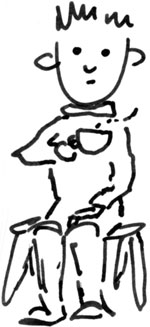
‘Drink a cup of tea,’ as they say in Zen. Don’t think about drinking a cup of tea — just drink it. Taste it. Feel it. Enjoy it. That is experience beyond thought. How nice! How free!
Meditation
We need a structure in order to begin, yes, and we need a timetable and a degree of discipline, most likely, but let us not misuse the props. And let us not count up the sitting hours as credits towards a degree in complete enlightenment to be awarded in later years, or in the next life.
Unless one’s motive for meditating is in order to wake up to reality in this moment, then it is doubtful if anything other than a sort of sleep, or negative mental state will come about as a result of it.
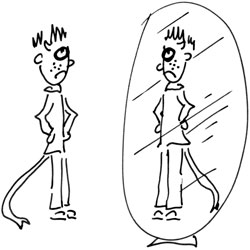
Meditation is the great antidote to ignorance. It allows us to see ourselves plainly as we are, as if standing before a large clear mirror. Nothing is hidden.
If the movements of the body and mental processes are observedintelligently and with an open mind, one soon becomes aware of the mystery in life.
Awareness in everyday life
Be aware of:
actions,
intentions,
emotional states,
mental and physical reactions.
Make an effort to remember to be aware.
Let the body be aware of itself.
Let things go — passing thoughts, opinions and emotional states.
Sitting meditation
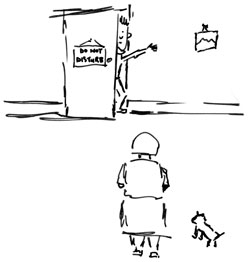 Find a quiet place where you can be totally free of interruptions — a room, if possible, or a small corner of the house. Make it very clear to husband, wife, children or anyone else living in the house, ‘This is a time I am not to be disturbed. Questions, telephone messages and miscellaneous bits of information can wait until I’ve finished.’ Be very clear and firm, otherwise your meditation will be tense and anxious as you sit in wait for the door to open and a voice calling your name.
If the rest of the family think you are crazy, fine. Confirm their worst fears. Yes, you are crazy and you are very happy about that. You are about to embark on an exciting journey and do not wish to be cheated out of it by others’ opinions. And don’t feel guilty about taking the time for yourself. It’s funny how others can become rather jealous of the odd moment one wishes to spend alone. You may well be accused of being selfish, irresponsible in your consideration of others, and of wanting to escape reality. Don’t be put off!
You don’t have to be alone, of course, if someone wants to meditate with you, or if you want to meditate in a group, go ahead.
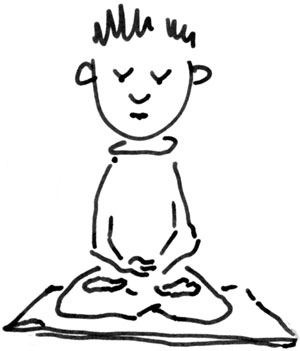
Now a sitting posture is to be adopted. There are several to choose from. Find the one which is most suitable for you.
A certain amount of experimentation may be needed in order to find the right position, one which can be held without too much difficulty for about twenty minutes. You may, of course, want to practise a posture at other times, one which you would like to be able to adopt, but cannot manage at the moment.
Hands and eyes
Open your eyes enough to be looking down at the floor a foot or so in front of you, without focusing on anything.
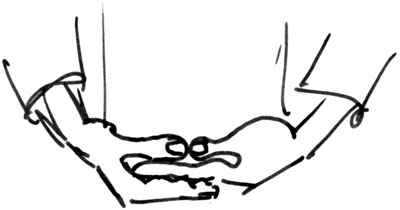
The hands can be held palms upwards, one on top of the other, loosely in the lap.
Duration
It is important to decide beforehand how long a session is to last, otherwise you will be thinking about it all the while and wondering, ‘Shall I stop now?’
Ten minutes is probably enough initially and can be increased to fifteen or twenty after a few days or weeks.
At the end of some weeks of regular sitting, thirty minutes would probably be more appropriate. Following on from that, forty-five or sixty minutes may be a possibility. Practised meditators tend not to sit for more than this length of time in any one sitting. You must judge for yourself what feels right.
The duration of the sitting is no mark of progress; it is the quality of each moment which is important.
If the sitting becomes an endurance test, therefore, it has lost its value and you will be wasting your time, or worse, you will be putting yourself off meditation altogether. Better to sit for a shorter period with enthusiasm and energy than to drag yourself through an hour faking it.
When?
When is the best time of day to meditate? Some say first thing in the morning, others say last thing at night. You must find out for yourself. The deciding factor may not be the state of your mind, but a busy schedule, or the busy life of your family. The best time may, therefore, be in the middle of the afternoon when everyone is out, or at dawn when they are all still sleeping and the air is clear, or at ten o’clock at night when the kids are in bed and silence reigns.
 You may like to sit more than once a day. Many people sit twice.
Meditate when you can, when the time is right.
Start
You have found a suitable place in which to meditate, and you have sorted out a nice posture in which to sit. The back is straight. The eyes are half closed. The hands are resting loosely one on top of the other, palms upward, in the lap. The physical side of things is all set. But what is happening in the mind? Is it calm and peaceful? Is it full of expectation? Is it chattering away to itself — imagining, wondering, worrying, planning?
Counting Breaths
Breathe in and count silently to yourself ‘one’. Breathe out and count ‘one’ again. You have now counted one complete breath. On the following inhalation count ‘two’, and ‘two’ on the exhalation. Continue counting for ten full breaths. Then start again at ‘one’. There may be some difficulty in retaining full concentration for the time it takes to breathe ten full breaths. The mind will probably wander. If it doesn’t, I would be very surprised!
If and when the mind wanders, therefore, and the count is lost, simply begin again at ‘one’. Should the counting become mechanical, again, go back to ‘one’. Another possibility is that you find yourself counting mindlessly beyond ten, and this will be a further indication of loss of concentration. Go back to the beginning again and again. You may find you can hardly reach ‘two’ before your concentration goes. It doesn’t matter. Reaching ‘ten’ is not the object of the exercise. Trying to do it is the purpose. And in that effort much will be revealed and realised.
Please don’t become frustrated or depressed on account of this inability to control the mind. You are seeing how the mind works. You are discovering how you work. That is why you are meditating. Be interested in what you are doing and what you discover about yourself.
Forgive yourself if you find your concentration is poor, and continue to make the effort. Make the effort, but without force; try to do it in a gentle way; gently bring the mind back to the exercise time and time again. Be patient with yourself. Let yourself be what you are, and try to stay with the counting.
There are many variations on concentrating on the breathing process, but I will list just three. Only one of them is to be used — it doesn’t matter which. They are all of equal value so there is no question of progressing from one to the other. Yet you may wish to try them all out as time goes by in order to see which fits the best. Finally, however, decide on one and stick to that.
- Concentrating on the length of breaths taken. Is it a long, deep breath? Is it a short breath? Or is it neither long nor short?
- Concentrating on the warm and cool sensations in the nostrils as the air flows through while breathing in (cool) and breathing out (warm).
- Concentrating on the rise and fall of the abdomen (approximately three finger-widths below the navel) while breathing in (rising) and breathing out (falling).
The breathing is a continuous process while one is alive and for that reason a very convenient subject on which to meditate.
And…
As the counting takes place to the rhythm of the breath, the mind will be calm and clear, if only for a little while. That moment or two of clarity will be enough to reveal the value of concentration. Worrying, hoping, dreaming and wishing cannot occupy a space already filled with the counting of breaths. This is a simple revelation which has a deep significance, to be contemplated and fully realised. Just by concentrating in this uncomplicated way, one can come away from, or dissolve, a negative mind state, even if it is only for a moment.
Meditation is a way of facing deep and real issues and of experiencing their transformation into something positive and creative.
After a while, a degree of concentration and calmness will begin to manifest itself and develop. It is impossible to say how long this will take. For some it may be almost immediate; for others it may take weeks or months, or creep upon them imperceptibly over a longer period of time.
When the time is right, the exercise can be dispensed with. But you must be honest with yourself. Is it time to leave this exercise? Has it served its purpose? There is no point in waiting for perfection! You may never count ten breaths without faltering. It is enough to establish just some concentration, and to experience just some degree of clarity and calmness. If you wait for perfection — an uninterrupted flow of ten counts over and over again for twenty minutes or so — you may wait for a very long time! Move on when you genuinely feel it is time. Experiment if you like; you can always return to this exercise again in the future if you feel you need to. It is all a question of finding that balance between moving too fast and not moving at all.
Nonattachment
Be aware of the breathing and be aware of whatever else passes by — a sense, a feeling, a thought, a smell, a sound. Let the mind open. Observe, but not as someone watching. Try not to become involved in thoughts. Let them fulfil their function and then let them pass on, otherwise you will not be free.
Nonattachment to all sensations — pleasant or unpleasant — is the route to happiness.
Good luck.

The above has been extracted from Experience Beyond Thinking A Practical Guide to Buddhist meditation Diana St Ruth